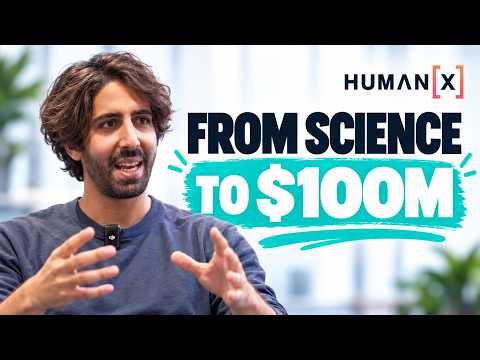
**From buying 30% of a startup just before COVID to selling it to Snap (Snapchat), and now building one of Europe's most ambitious AI hubs.**
In this episode of Nectora, recorded at HumanX Amsterdam, we sit down with **Esther Bisschop, Founding Director of The Stack**, to explore her unconventional career journey, the challenges of entrepreneurship, and the future of Europe's AI ecosystem.
Esther started her career in cultural anthropology before transitioning into technology, corporate leadership, and entrepreneurship.
In December 2019, she acquired 30% of Th3rd, a startup developing 3D scanning technology for fashion products. Just three months later, COVID disrupted almost their entire sales pipeline.
▸ Read the transcript
we knew that AI was coming. So our other co-founder, our technical co-founder had already been warning us like, guys, you know, we're like machine learning AI is going to pick up the pace. And we need to be ready for this. I would love for the Netherlands and also Europe to be way more bullish on the opportunity that's ahead. What we want is the brightest people, the brightest minds with the most the brightest minds with the most ambition and the highest ability or ambition and the highest ability or creativity to innovate. documentary and I, yeah, but then in the end, I thought, yeah, I really would love to do something with cultural anthropology and tech. Humans and technology and just put the bridge of education And I loved that combination. But then all of a sudden, when you become partner and you become director, I kind of said, "Nah, it's going to be fine, you know, we can still do it." But it does happen. And still do it." But it does happen. And the whole narrative flipped and I signed for, I bought 30% of the of the shares. And then in March shares. And then in March 2020, COVID happened. Yes. And 2020, COVID happened. Yes. And the whole thing just kind of broke down, the whole thing just kind of broke down, let's say, at least our wow, I bet it on this company on this startup, like, yeah, I gave up my I need we need to do this together, right? We need to move forward. together, right? We need to move forward. Hello guys. Here we are with Esther Bisschop, founding director of The Stack. So we are going to ask her some questions. First of all, who is Esther Bisschop? Nice to meet you. Nice to meet you. Thank you for having me. Thank you. Who is Esther Bisschop? Who is Esther Bisschop? Well, I'm 48 years old and I live in Amsterdam. I have two kids and I'm the founding director of The Stack. Okay, perfect. So you started your journey, let's say career journey as a cultural anthropologist. Yeah. And then you transitioned into tech. Which was your first position in tech and how did you go from cultural anthropologist to the director of AI Hub? Yeah, yeah, well, it was quite a bit of a journey, right? But yeah, I studied cultural anthropology because I have, or at that time I had a, and still do, broad interest in humans. How do humans behave, especially in groups? Like what is culture? What are the unwritten rules that we all live by? And I was kind of fascinated by that. Also, my family has a very international background. So I kind of grew up with all these different perspectives on life and how to kind of behave in different cultural settings. And I think, yeah, that kind of led me to deciding, okay, I'm going to study cultural anthropology. Of course, it's a bit of a challenge, let's say, to get a job in that because there are very few companies that ask for cultural anthropologists in any job opening. But during my studies, the internet really happened, or during high school actually, and mobile phones. So while studying, I thought, wow, this internet, now the era of AI sounds like really long time ago, but the internet is going to have a real impact on how humans behave and also on really fading away, maybe the distance between people and also cultures, right? It's going to unify people a lot more. So unify people a lot more. So I was just very interested what the internet was going to do and what kind of effect will it have on humans? And that's when I decided to do a minor in, I think it was multimedia technology at that time. Informatics, kind of. Exactly, informatics. And I decided to do my thesis on the effect of internet cafés on young people in a specific region or village in Mexico. And I thought, yeah, it's just a nice way to weave those things together, like both of my studies, cultural anthropology and informatics, and see what kind of effect the access to the internet, let's say, has on young people at that time. And I really loved the whole combination of understanding humans and human behavior in relation to tech. And that's when after my studies, I went on to look for a job and I did a lot of different things. I also traveled, made a documentary and I, yeah, but then in the documentary and I, yeah, but then in the end, I thought, yeah, I really would love to do something with cultural anthropology and tech. And I started working And I started working at a company at an agency here in the Netherlands that was specialized in e-learning, so digital learning. Now it's like super common, but at that time it was upcoming as well. And I really loved, so it's like humans really loved, so it's like humans and technology and just put the bridge of education between it, right? And I loved that combination. I could do my cultural anthropologic, I could see through my cultural anthropological lens, talk to companies that needed some kind of education for their employees, and then together with my colleagues who were very good at the educational science, like didactics, think of ways to solve the educational challenge that this company had through behavior of people, right? So I really loved the fact that I could kind of use my anthropological lens to then build a solution for companies that wanted to educate their employees on a certain topic. And I stayed with that company for quite a long time. I started as a trainee actually, just fresh out of college and worked my way up, let's say. And I noticed that what I really loved is just to go towards the customer more and more and more, like what is the actual problem that we are trying to solve? So from a project manager, I became an account manager, and then in the end, I ended up being the operational director of the company and also a partner, so a small shareholder. And that is also where my entrepreneurial journey kind of started, because it's my first experience as an entrepreneur. How do you go from employee to partner? Yeah, that is a whole journey in itself, and also a challenging one, because my transition, let's say, was after six years of being in the company, and I was very much one of the guys and girls, right? One of the group. But then all of a sudden, when you become partner and you become director, you do make actually a switch, you do make a transition. And I kind of said, "Nah, it's going to be fine, you know, we can still do it." But it does happen. And that was challenging for me. But in the end, what actually really helped me was a colleague who said, "You know colleague who said, "You know what, Esther, every company needs a director or needs directors, a team of leadership. So go take that steering wheel and be our captain." And that kind of felt like, to me, it felt like she had given me some kind of permission to be the leader or part of the leadership team of that company, and that she kind of trusted me to do it right. And I, yeah, somehow I needed that in my transformation, maybe, to become part of that leadership team that I was kind of supported by the people who were before, like just my co-workers, right? But co-workers, right? But then, yeah, all of a sudden, you're in a position where you really, yeah, you call the shots, you make the decisions, you also make difficult decisions. And you also make difficult decisions. And you go from maybe being concerned about your own job and how to do it right. And also your position in the company, you really zoom out, and you feel responsible for the whole company as an entity, right? And that's, it's a very different lens that you, yeah, you find yourself or different lenses you look through. And it's also a very different responsibility that all of a sudden you have. So for me, that was definitely a steep learning curve, but also a very good transition. Yeah, it opened up a whole new perspective for me as an entrepreneur, also as a, as a leader in a company on how that works. Then you started working for proof, right? Yeah. Which I assume allow you to enter also into that test. Yeah, right. Yeah, exactly. Yeah. Can you explain us a bit how, how did you get Proof and then transition there? Yeah. So after a total of 12 years at that first e-learning company, TinQwise, I, well, after 12 years out, like I did six years in it as an employee, and then six years as a partner and director of operations, I just really felt that it was time to move on also to explore new things. I had at that time, my husband and I and we had two small children, four and one years old. And for both of us, it was really a time to kind of zoom out, step away a little bit from the lives that we had been building. So we went on a sabbatical. Now my ex-husband is from Ecuador. So we decided to travel with our kids and do a road trip for a small year. So we went to explore South America with our kids, which was the best decision I, we ever made. Like still, look back on that decision with so much pleasure and happiness. And the fact that we did that as a family also to really spend time with your children when they're small for me was a super precious gift that we kind of allowed ourselves to have and to unpack. And after that, we came back to the Netherlands and I decided to, to continue as a freelancer because I kind of also wanted to explore like who am I apart from this first company and where I worked, apart from this, let's say, director title, what else is there in the world? What else can I do? And then I started working at Proof as a freelancer and they kind of deployed me in different companies and one of them was Tata Steel. And I thought it was just super interesting as well for me to work because I had on the agency side for so many years. And now I could see the corporate world, let's say. Yeah, and it's also very interesting environment to be in as an anthropologist, but also to look at how processes go, how decision making goes, who's calling the shots, how do you do stakeholder things from that period? And you enter in a period of merger, right? Sorry. You enter in a period of a merger as well to Tata Steel. Yeah, exactly. And then something happened. I assume you were hired for something and then your role evolved into other tasks, right? Could you explain us a bit about that? Yeah. So indeed, at that time, Tata Steel was exploring a merger and that didn't happen. So we prepared like this. I was in part of the communication department and we were preparing the whole workforce to make that transition. Yeah, and then you're kind of prepared for this whole thing to happen and then it doesn't happen. Still, it's very good learnings, of course, but it's too bad that it doesn't happen, that it doesn't actually become real. But then they asked me to stay on longer because they wanted to make the internal transition to work in a way more agile way. So I became a program manager for that on the communication side, how to take along the whole workforce in the shift of way of working, which was also an interesting journey. Yeah, and that's what I did there. How does the communication strategy differ when a merger and then when something like more layoffs, something like that happens? How did you manage this transition from a communication perspective? So also in the merger, there were a lot of different facets, right? That were part of that. It's about indeed what happens to my job, but it's also about how will this whole merger happen so it's a lot about expectation management. It's a lot about the what ifs, addressing concerns, addressing questions that people have. And in the actually the transition to agile working, it's more or less the same, right? It's a transformation as well. So yeah, It's a transformation as well. So yeah, you I don't think you do a lot of different things. I think there are a couple of really good rules in communication and how you do communication well, especially also internal communication. And it's it has a lot to do also with leadership, right? I mean, you need to communicate, over communicate with your employees and be very clear about what is going to happen, how we're going to go about what will happen, what will not happen. And taking a long leadership in how to do this is a very interesting and fulfilling program to run. It's very, for me also, it had really good learnings. Yeah, well, I think if you do it right, every step of your career has a lot of learning. And I assume in the COVID times, there was also a kind of communication challenge, let's say. But then actually, I already started my startup. In the freelance period, my brother actually had started the startup together with another co-founder. And I was working four days as a freelancer. And one day I was at home, my kids at that time already went to school. And I, yeah, my brother and I were just brainstorming lots. It was really nice because he kind he kind of started asking me some questions because he said, Yeah, I'm starting this company. And you have this experience from your first job as a operations director. Can I sometimes pick your brain? I was like, Yeah, yeah, why not? Which was a functional position of your brother at the time? Like, what was his founder? He was founder, right? Founder of the startup. Business oriented tech oriented? Oh, um, yeah, business strategy, I would say, yeah, because he has a background in business administration. So definitely on the financial, but also on the strategy, strategy more vision, part visionary parts, and his co-founder was very technical. And he Yeah, we just kind of brainstormed. And whenever he had like, a thing that he wanted to talk about, he would just call me, he needed a place to stay in Amsterdam, because his business was was there. And he lived in the south of the Netherlands. I said, Well, just stay at my place. And, you know, it's nice. And at night, we were just always brainstorming about his company. And then he said, Like, wouldn't you want to join or somehow cooperate with us? And I said, Well, yes, but yeah, of course, we're also brother and sister. So let's see how that goes. And now we still need to be able to celebrate Christmas together in a good way. So maybe let's just try it out. I now work four days as a freelancer. So I have one day to spare, I don't mind doing some stuff at night. So maybe let's just try it. And then we see. And that's kind of how it came to be. And I just, I just kind of jumped in wherever, like, I think I'm pretty good generalist or taking on different hats and kind of seeing what needs to be done. And I think that's also as starting a company. Yeah, your scope as a founder is so broad, because you need to do everything right. And for those guys, I was just an extra help extra pair of hands and then also an experienced extra pair of hands. And that just kind of escalated in a good way. Because after about a year or two, they said, you know, we really would love to get you on board officially. So I started helping out in 2017. And then in 2019, we said, Okay, let's make a deal. And actually, the business was going really well. So we were growing, we just won a big accelerator program by Adidas. That was Th3rd, right? That was Th3rd. Yeah. So what was Th3rd at the moment? And how you evolve it at the end? Yeah, so at the beginning, it was just a very small company still, I mean, we definitely when I joined, they had already been working a couple of years. But they were actually working on a on a different kind of business solution. They were doing 3D model human marketplace. So human images, that's really models of humans in a market in a digital marketing place, sorry, digital marketplace. And actually, when I joined, we decided my brother, this was not my idea, but my brother's idea to pivot to products, doing more product focused work. So doing 3D scans of fashion products. And we built a product scanner. And I just helped them wherever I could, like also with clients and more the commercial side. And because that's what Yeah, that's what we kind of said, like, you're such amazing things. But it feels like nobody knows what you're doing, right? So you need to get out there. But they just didn't have the time also to do that commercial outreach. They were very busy, like also developing really the technical innovation and making sure that the find we were bootstrapped. So you're all in a constant a constant race to survive every month. So my extra pair of hands went to like commercial efforts. And we really saw that. Yeah, we grew we want a big accelerator program. Adidas was very interested in working with us. We had the possibility to build a product scanner on site for them in their photo studio to 3D scan their whole new collection of shoes. And my brother said, you know what, I think if you want a piece of this pie, and you want to join as a late co-founder, you need to jump on the wagon now. Because if we do this accelerator project really well with Adidas, we're probably gonna get on board some investors. And I would rather have you join before that. So we made a deal end of 2019. I think December 31, I signed for, I bought 30% of the of the shares. And then in March 2020, COVID happened. Yes. And the whole thing just kind of broke down, let's say, at least our let's say, at least our sales funnel really broke down. And that was also because we were very much in the bucket of let's say innovation for fashion brands. And I don't know if you remember, but like also the whole fashion market had huge challenges shipping their products to Europe from Asia. And there was just so much. Yeah, let's say panic or fear, so much uncertainty. in the starting days of COVID, everybody just pulled the plug on all the fashion innovations. So we like all of the things in our funnel just dropped almost all of the things. So there was a super hard the things. So there was a super hard challenge to overcome. And also for me personally, I was like, wow, I bet it on this company on this startup, like, yeah, I gave up my relatively comfortable freelance but now I'm yeah, I am co-founder, right? I am co-owner. So I yeah, I need we need to do this together, right? We need to move forward. And yeah, luckily, we found a way to do that. We really got together as founders and made a very strategic plan like, okay, how can you still make money? Because I just stepped out of the freelance role, I said, you know what, I can see if they can extend me. And then thirds can kind of rent me out as a freelancer, I can get paid through the company instead of on my own account. We can at least do our groceries and kind of see in a couple of months where we land right with this whole COVID thing. And that kind of pulled us through in the initial phase, like when the everybody's like, oh my god, what's happening? And then when things kind of landed and the dust had settled, or how do you say like the dust went away. Then we saw that, again, projects were kind of picking up slowly and things were kind of on the on the way again. So that's how we kind of survived that first really strange experience of, yeah, the pandemic. And then in the yeah, the pandemic. And then in the second year of COVID, actually, the whole script, the whole narrative flipped and e-commerce became like the next best thing, like the big hype, the metaverse, we were all gonna shop with virtual behavior change. Yeah, exactly. Everybody even went shopping online. Yeah, this whole promise around the metaverse of like magic mirrors, virtual try on virtual fitting, like super, like, really boosted. And that was exactly where Th3rd was in that space, right? So then we said after COVID, or kind of when it's when it kind of in the last months, we said, okay, it would be good to actually this was I think, 2021. End of 2021. We said, Okay, now we need to really double down on our solution. But we wanted to get some investors in. And actually, we wanted to partner with Snap. And also some other players in the same space, AR (augmented reality) solutions, to show what our so yeah, what our product was, let's say, because it's very hard to explain what a 3D model does. So capturing a fashion product in 3D, and then showing what, what that opens up in possibilities for marketing for gaming for, it was just very hard to explain, you really need to experience it and see it. And through the through an augmented reality lens, you can easily show like the power of having a 3D model. And remember, this was all before AI, like it was nowhere near easy to create something in 3D, like it is now, right? So we then got in touch with Snap, actually, because we wanted to partner with them. But that they found our solution so interesting, that we kind of realized after a couple of comfort, for conversations, we said, Hey, maybe they want something more, right? Maybe they want and that's also when they were pretty transparent. They said, Well, investing is one thing, but we would actually like to talk to you about an M&A. Okay. Yeah, so then we got together as our three founders, and we said, Okay, what are we going to do, you know, it's still quite early in our journey. But we had also seen like the hardship of entrepreneurship, of the entrepreneurial journey. In a big thing, like a pandemic, we knew that AI was coming. So our other co-founder, our technical co-founder had already been warning us like, guys, you know, we're making a very heavy hardware based solution. But actually, like machine learning AI is going to pick up the pace. And we need to be ready for this, we either be ready for this, we either need to kind of pivot towards building that. Yeah, or see how we can otherwise kind of mitigate this and then when Snap said, we would love to buy your solution. We also said, Okay, maybe that's actually a really nice way to also monetize on what you've been building for so many years. And also to be part of a bigger company, right? And I mean, Snap was, is of course, a very big international player, and they were working with all of the same brands as we were working with. But then it's so much easier to work with them. Yeah, being part of Snap instead of being a very small startup still in Amsterdam, right? So that's why we decided, Okay, let's let's go. How do you sell to tech guy and yeah, it's one thing that you have to do. It's very challenging, especially for us as well, because we were still bootstrapped. So the valuation of your company is very difficult when you're bootstrapped, because there's no data on like the investment part of it. So it's very, it's pretty hard to calculate. So that was definitely something that we also got help with. Although for experts, financial experts, it's also really hard to, to give you advice on valuation in a market that they actually do not know a lot about, right? So it was very much also my brother, with a financial background who really, yeah, I think did a very good job there, to really express our value, because like the value you see in your company is one thing, but you really need to think about, okay, what is the value to them? Like, a Snap wants to buy us has a specific idea around acquiring us. And what's that worth to them? And that's something that my brother did really, really well. So because of him, I think we had a nice exit for what we were at the time, right? We were still small, but we had a pretty good exit, actually, for what we were worth, or what we were gaining in revenue every year. Yeah, and also we had very, I think, still at that time, very, very interesting tech. And we were ahead of the game for sure. So I think either, like both parties got a good deal in this. Yeah, and that was, yeah, it was just very interesting journey, of course, also, you're very small. So you feel like David and Goliath, right? And like a lot of calls, you're okay, very professional team of advisors and legal people on the Snap side. And then it's like, yeah, me, my co-founders, and one advisor. Yeah, but you learn a lot. Yeah, you learn a lot. Then I assume you got approach to be the funding director, right? From TechLip. From the Lik AI initiative, AI Hub. And then I assume that transforming to an independent stack, right? First, what's on AI Hub and how was the origin of this transition? Yeah, yeah. So I left Snap at a certain point. And I was in a sabbatical and I had a little bit of the Exodus founder syndrome where you're like, okay, yeah, I sold my company. Now what? Right? Am I gonna, like, our exit was nice, but it wasn't enough to completely stop working. I wouldn't either. Or also, I mean, I really love building stuff. And I love working and creating things. But I also felt, let's say not a financial need instantly. But yeah, I also felt like I don't want to be outside of the game too long for different reasons, right? But I remember sitting at home enjoying my sabbatical and kind of feeling like I was the kid inside. While all the other kids were playing outside in the play, I was like, I also want to play outside. So I started looking for my next challenge. Talked to a lot of people. Thought about like, am I gonna entrepreneur again? Yeah. Am I gonna maybe work for an investor? Could I maybe join as either a late co-founder or as part of the leadership team in a scale up? I investigated a lot of different roles. And I actually knew Techleap already because of my entrepreneurial journey with thirds. And I also talked to them and I said, Hey, do you maybe because I wanted to be part of still this ecosystem of startups and scale-ups. I really love the energy. I love the builder mode. And I didn't want to yeah, go away from that, let's say I wanted to be inside of that group still. And they actually began working on this crazy idea to build an AI hub here in Amsterdam. Like we want something like station F, but then in the Netherlands, and really thematic, like focused on AI, because we feel a lot of urgency. And there are a couple of tech founders who are super motivated to get this off the ground. But yeah, we need somebody who can build this. Would you be interested? And I said, Well, sounds like an amazing challenge. I've never done anything in real estate. But I am a builder and I'm definitely entrepreneurial. So I'm super willing to take on the challenge. And if we can find the right experts that can help us, then let's go. So that's how I became part of the team that built The Stack. And now fast forward, let's say, little over a year, yeah, we opened our doors, the first floor is live. I'm super proud of what we've done in such a short time. Because we signed the lease contracts early May. And now we opened the first door in our first floor in September. So in five months, we've built this amazing office space. And we're going to grow towards the end of the year, we're going to grow to four and a half thousand square meters, available for a very curated group of AI companies. And actually, we have the ambition or the possibility also to grow up till 12,000 square meters. But curation is what drives the growth of The Stack as well. Like if we really want the best of the best in house, so we're not gonna allow any kind of company to be part of the stack. But if we have a lot of interest from a lot of interesting companies, then we'll definitely have the possibility to grow. I wanted to actually touch on that. With all the innovation happening in AI, all the transitions, some companies die and some kind of companies leave new trends of in AI. Who do you reject? And how do you stay up to date to the new upcoming companies and to the old outdated companies in AI? Yeah, it's a very good question. So they're all, and like I think any other real estate projects, which maybe stay away a little bit from a very volatile public, very volatile group, like startups and scale-ups, because yeah, they will not be able to sign a five or a 10 year contract. So by design, we're very founder friendly. As a company, you can sign at least for a year for two if you want to or three if you want to. But we started even six months if you need. So in that respect, we want to be super friendly, founder friendly, you'll have the ability to grow inside of The Stack as well. So as your company grows, you can grow. But we also take into accounts that there will probably be a lot of companies who won't survive. So we need to be super on top of our game and make sure that we can instantly then also fill the space with another the next promising entrepreneur. We do this by we also have a launchpad. So we rent out desks to very promising first or second time founders or even multiple time founders. And you see that this actually is, how do you say growth space for their next step space for their next step in their journey becoming a company. So we aim to get every stage of growth, let's say in our stack, it's all early stage or up till like 50 desks. So if you become larger than 50 desks, you need to move out of The Stack, which would be for us a very good proof point that we did something really well, right in that because we were able to help you grow your company up to that point. But yeah, it's a it's a pretty tough, let's say selection that we do because in order to fill our space, we had to deny like a big way bigger number of companies because of that, right, because our funnel, of course, is way bigger. And then you end up with a small amount of companies that actually make it into The Stack. But I do really also believe that doing that high creation makes the stack to what it is. I mean, the whole real estate place just a means to an end. What we want to an end. What we want is the brightest people, the brightest minds with the most ambition and the highest ability or creativity to innovate. We want to bring them together in one space and really create that flywheel, right? Because if we can promise to the whole ecosystem that we have the best of the best in house, then that will attract all of the things that will make the flywheel work, right? So we'll attract the right investors, we'll attract the right corporates who want to work with us. We'll attract all the right ecosystem players who want to support these companies because we've already done good sourcing and good selection. Right. So doing that creation actually is our gold, let's say. How does the ecosystem work? How do corporate investors and startups and builders interact together? Yeah. So if we put the founder together? Yeah. So if we put the founder or the startup in the center, of course, there's a lot of things need to happen for a company to be successful. Right. It's not only a good entrepreneur with an awesome idea. I mean, you have to a lot of things have to happen at the right moment in the phase of that journey. Let's say you need to have a really good product. You need to have a really good team. You need to have product market fit at some point. You then need to attract capital. You need to be in the right place to have your first customer, your design partner, maybe as a customer. All of these things need to happen. And that is something that I think in Europe and in the Netherlands is challenging in any way because I think being an entrepreneur is a challenging thing. But if we can then support and help getting all of those, let's say, points right in the journey or at least give you a little bit of help to continue on to of help to continue on to that next phase, then that is what we're there for. Right. That is why we founded this stack. I wanted to ask, which is the business model of this stack? Is it only a real estate company? Is it also an investor? No, so it's it is definitely a non-for-profit. So we don't want to make any profits. All the profit that we might make directly goes back to the founders. Governance wise, we're a private entity and we have two shareholders. Techleap is one of them. Not sure if everybody knows Techleap, but it's a very passionate ecosystem player it's a very passionate ecosystem player who really exists to help founders skill their company. And Techleap, let's say, jumps in the gap that we see in the ecosystem, in the broader ecosystem in the Netherlands and tries to make sure that the path for a founder is easy. So Techleap is one of the shareholders and then the other shareholder is a corporation of founders. And all of the residents, all of the members inside of the stack automatically become part of the corporation. So actually, when you rent an office in The Stack, you also automatically become part shareholder. And we did this on purpose because we want to be a founder led hub. They also have a couple of veto rights in order for it not to become a real estate play or one of the corporates, maybe one of the founding partners getting too much, let's say, whatever power, they don't have any governance, but we don't want a big company coming in and all of a sudden defining the rules. So that's why we chose this governance, but it's fully private owned and founder led. And the business model is definitely not only a real estate play. We have founding partners who support us financially as well. And we'll have very much a passion and a motivation to make sure that flywheel we want to create for the startups and the scale-ups in not only the Netherlands, but also in Europe happens. So these are all the founding partners are all companies that have a very strong motivation for really supporting that innovation layer, let's say of society. Yeah, and that's how the business model works. Now related to Europe, which part of the AI stack should Europe have as you know, the latest frontier models are made by US, China, and in Europe, I think we are doing more vertical things. What's your opinion on how Europe should compete with these big countries? Yeah, yeah. There's a lot of talk right about Europe missing the boat and about being behind I think there are way more boats that will come. So maybe we missed this first boat, but let's jump on the next right. The stack has a philosophy, we want all of the layers of The Stack inside of our hub. In order to double down on all of the different, let's say solutions that the total AI technology needs. We see a lot of money and interest now go to deep tech and AI, and especially the combination between deep tech and AI. And I think the Netherlands is also strong in this respect, right? So I see a lot of opportunity there. And yeah, I think the next wave of AI models, right world models, action models, I think those are definitely I'm not sure if the world model specifically has, well, we have general intuition, of course, we can definitely course, we can definitely double down on that. And I think also as Europe, we shouldn't think like, oh, we missed one boat, okay, let's just give up. And I'm not saying that we are. But I think, yeah, we should be a bit frustrated. I think also the frustration and the urgency that we feel good, right makes us a little bit angry. And then I hope that, yeah, people will really pull themselves together and show, yes, we can. And the next best thing maybe will be ours, right? There's also now a lot of, of course, in the news, also a lot of worry, and I think fear around the security of AI. And we've been sometimes seen as, oh, yeah, Europe over regulates Europe is like the police person in the world, right? But I think there can also be a lot of opportunity there. So if this is culturally in a sense what Europe already kind of owns, then maybe we can be maybe not the police agent in the room, but maybe we can be the mature person in the room, right? When you think of risks that also come with AI development. So yeah, I think there are definitely a lot of different areas where I think Europe can be super strong. And I see a lot of potential. Yeah. Related to this success, how would you know in five years time if The Stack has succeeded? Which kind of champions will The Stack produce? Yeah. Well, of course, we hope for a couple of unicorns. Yeah, but I think there are a couple of things that we really aim for, like what we see in the Netherlands, and I think in Europe in general, is talent that leaves. It's very hard to find talent. While we have a very high AI talent density in the Netherlands, especially, but a lot of this talent does not transform into new innovative companies. And that's because talent either leaves and go abroad, or it starts working for big tech. And I would love for more talents to stay in the Netherlands to also start their own company or work for a scale-up or a startup really bringing that innovation to the world. So I would definitely want to see more talent in the Netherlands. Hopefully, we would attract more capital I would love for the I would love for the Netherlands and also Europe to be way more bullish on the opportunity that's ahead. I think there's that's ahead. I think there's been a lot of talks about, oh, everybody's gonna lose their job because of AI. I don't know if you feel this as well, but I feel it here as well at HumanX. You just feel like the immense possibility that is out there. And if we jump on that wagon and also put our money where our mouth is, then we should really be able to make a big boost or a big way forward. So in five years, I would love to see a very, more mature stack, 12,000 square meters, if it's up to me, with a very vibrant community, really attracting a lot of talent, driving a lot of innovations, not only for Europe, but really for the world. I would love to see a couple of maybe now see a couple of maybe now small companies turn into real big global players. So we can have a say in the future of where the world's heading as well, as Europe, of being Europe. I mean, I think now we let our future also be dictated by other bigger powers. And I would love to be able to, as Europe, sit on the table. Have your views on exiting a company changed with this new wave of European sovereignty? Sorry, has my? Your views on exiting a company changed with the new things, thoughts about the European sovereignty? Um, yes, I've sometimes questions like should we should we also have sold to an American company? Although I do also think that it's very Although I do also think that it's very difficult, right? Because you see that now as well, I think 75% of capital for European scale-ups comes from the United States. And do you then say, oh, yeah, no, you know what, because of sovereignty, I'm not going to take that money. No, we should really work together still, right? And also with the big tech players, I think, and it's not enemies, but keep your enemies close, right? I think instead of steering away, I think we should pull more together. Be cautious, definitely. But we should learn, right? We should learn from the other party or also with American capital, you open up a lot of possibilities for European founders. So we should not steer away from of that. And I mean, the fact that we exited, yes, to an American company, but also put me in a position where I'm now able to build a stack. And we also learned from that experience. And we can also within, let's say, the founder journey, give back to other founders that are now in their early days of their founder journey, right? So I think having those exited founders in the Netherlands, even though they sold maybe to an American company is very important. Do we lack capital in Europe or a lack of initiative to aggregate it somehow? Because I see a lot of startups that have successful products and are asking for checks in Europe, and they tell me, we need to go to Americans at the end. Yeah, yeah. So what's our problem in Europe? Yeah, yeah, big question for me to answer maybe. But what we see is in reports and everything as well is Europe is more risk averse, right than the United States. So I think especially startups and scale-ups, of course, feel this because it's per definition, risky business. I myself experienced as well as a founder, like doing business in the United States is very different, you need to present yourself differently, you need to tell your story differently. You need to tell a big story, right? You need to tell or express your vision. And I think we as Dutch founders tend to be very honest, very, let's say, humble, very realistic about the opportunities or the upside of our company. And that is not always a good thing if you want to raise money, right? I don't think that there is a lack of money. Because I think if you just look at the facts or the data, there's enough money in Europe, but it doesn't get deployed to the risky business, it doesn't get it doesn't end up with a with a scale-up founder, per se. And I think in this, the Americans are, yeah, are way better and more opportunistic and taking risks than we are here in Europe, unfortunately, unfortunately. Yeah. And last two questions. If you had the youngest heir in cultural anthropology in front of you, what would you say to her? What would I say? Wow, enjoy the ride. Definitely. Yeah, I don't know. I look back with a lot of joy up till now on my journey. And I'm very much looking forward to all of the hopefully cool things that are still to come. I'm now 48. So I'm Yeah, in two years, I'll be 50. And I don't think honestly that I've ever regretted where I was at different moments in my life, right? I mean, there are definitely, I know, like, becoming 30 is a big thing. And becoming 40 is a big thing. And now becoming 50 is a big thing for me. I think for every human that those are kind of ages that you kind of look back on your life and you go like, I'm already 40. Oh, I'm already Yeah, right. But if I genuinely look at, okay, I'm turning, let's say 30, or I'm turning 40. Where am I at in my journey in life, I can only be super grateful and happy that I am where I am, right? I'm healthy. I have two my career has been very exciting and full of learnings. And I've met so many interesting people. Like I really enjoy the rides, right? And I think, yeah, I don't know, like, like, I think to any other founder or female founder, I would say, just jump on that wagon, you know, take the chance, especially when you're young. Like, I think I joined the wagon, or how do you say I joined the startup when I was already, like, I already had kids, and it gave me a little bit of freedom because of my freelance job. But I think especially when you're young, yeah, there's so little risk actually, that you're taking, right? Maybe you don't have a mortgage yet. You don't have kids yet. Maybe you have a partner, maybe you don't, but you have a lot of freedom still, right? And that is something I noticed now in my where I'm at in my life. Yeah, you definitely have more obligations, responsibilities in your life. People around you who deserve your time and attention for me, like my kids, I think when you're in your 20s, yeah, you can just pull out, like, go, entrepreneurial path, like do your thing, right? And I think that, yeah, that's maybe an advice that I would give a younger person in general, enjoy your freedom, right? Enjoy. Yeah, like your 20s are really, if I look back now, my 20s were like an amazing time of my life. I was already making money. And I still had like so much freedom to do whatever I wanted. So I think that's the best time to start your entrepreneurial journey. Like you have very little to lose. Yeah, a lot of our audience are entrepreneurs, founders. So which is one lesson that you will tell founders today? Yeah, I think the one I just shared, right? Like, just do it. I mean, take the risk, especially if you have little to lose. If you can look at it as like, I wouldn't start a company with the expectation or the assumption that you will be very successful, because the chance of that happening is small. But start a company because you really feel that there's something you can disrupt or a solution that you can build, something that can maybe improve the world or maybe improve the field of work that you're in. And take the risk, right? I mean, it's definitely challenging, but it's also very rewarding. It's a very interesting journey. So if you're thinking about starting a company and you're still in doubt, I would always say, try to take the chance, especially if you don't have a lot to lose. And if you fail, then you fail, it's fine. You know, you've maybe had a great period of trying, you learn a lot about yourself, you learn a lot about the world, you learn a lot about really being your own pilot in life, becoming a self-starter, because there's nobody else telling you what to do. You really need to have that discipline yourself, yeah, to go forward. And I think it's just a very good, way to really, let's say, personally develop yourself, but also to learn from what that challenge can bring you as a person. So when in doubt, I would say just try it. And if it's not for you, then you can always stop, right? You can always pull the plug after six months or a year or whatever. That was it. Thanks so much. Thanks.