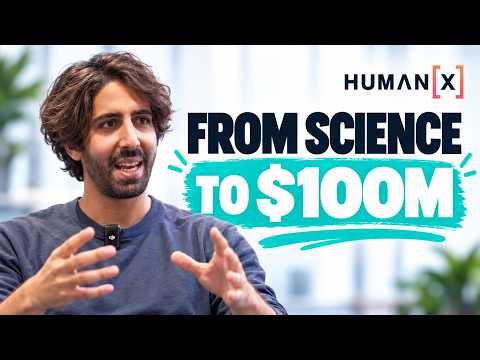
From corporate lawyer to AI founder. Prabhu Narasimhan, Founder & CEO of @BRAHMA AI, shares how he built an enterprise AI company generating nearly $74M in annual revenue and raised approximately $150M in funding.
At **World Summit AI Amsterdam**, we explore his journey from White & Case and private equity to investing in DNEG and bringing together technologies to create BRAHMA AI.
**Key highlights:**
- Why he says he has never negotiated, even as a lawyer and investor.
- How BRAHMA AI combined DNEG, Metaphysic and Prime Focus Technologies.
- Lessons from his investments, including Better and its $1.6B PIPE financing.
- Why Europe struggles with risk capital and why people matter more than technology when adopting AI.
- His vision for enterprise AI and the advice he would give his younger self.
▸ Read the transcript
I have never really negotiated in anything I've done in my life. I don't really believe that negotiation is a good framework for a good relationship. There is no business which doesn't have risk because if you did not have risk, you would not really be investing in it because you won't get a suitable return. One of the major investments I made was in a company called DNEG, which has won eight Oscars in the last 12 years for visual effects. And so got to 2024, I was going to hire a CEO, a professional CEO, and then we were going to launch Brahma. I then took on the role, reluctantly, [music] that of a founder and CEO of Brahma, and that is how Brahma was launched. I think we have been able to scale up pretty rapidly. Our revenue for the previous year that we closed is almost $74 million as you rightly mentioned. You are able to integrate technology if people are willing to accept that technology and adopt that technology, which [music] means you have to skill them, you have to upskill them. You also have to make them feel that the company is still human-centric and that humans have a role in the in the whole new AI universe. And as long as you're able to do that, I think AI will get adopted. If you look for outcomes and results, you lose focus on what you're doing. I'm pretty sure there'll be disruption. You can never control the consequence. Hello, guys. >> Here we are in World Summit AI, and today we're interviewing Prabhu from Brahma AI. Nice to meet you, Prabhu. >> Thank you. >> So, we discussed before, you are not coming as a traditional startup founder bootstrapping the startup, but you are coming from a more law and M&A background. Could you tell us a bit first about your your origins? How did you start that in in your career? >> Sure. No, thank you, and good to be speaking to you. Absolute pleasure. Um I was a lawyer originally. I was a partner in a law firm called White & Case. Uh and one day I decided that I was going to leave law and establish my own alternative investment firm, uh which was backed by um a previous client of mine and then uh it was joined by a couple of other previous clients of mine. So, before you know it um, I had uh almost in excess of 1 and 1/2 billion dollars asset under management. Uh so, launched a pre-IPO private equity firm uh and then started making investments. One of the major investments I made was in a company called DNEG, uh which has won eight Oscars in the last 12 years for visual effects. And the whole hypothesis is between behind me investing in DNEG was that I wanted the technology of DNEG, which creates some of the greatest visual illusions that uh uh humanity has seen to be taken out of just film and TV and to be applied elsewhere by fusing it with AI. And so, got to 2024, I was going to hire a CEO, uh a professional CEO, and then we were going to launch Brahma. Um came to the conclusion that uh the passion that I had for the vision and uh the support that I had from the investors, including DNEG, uh meant that I then took on the role, reluctantly, that of a founder and CEO of Brahma. And that is how Brahma was launched. >> And Brahma now serves clients such as Warner Bros, NBA, etc. >> Yeah. So, I think um uh Brahma is uh more uh a product of my tenacity uh as much as it's also product of serendipity. So, we fused three companies, made a major acquisition called Metaphysic, um which is one of the best-known AI um facial transformation company. Um so, acquired that, fused it with Prime Focus Technologies, which for almost uh over a decade was preparing and kind of architecting media asset manager, and then obviously introducing agentic AI tools into it. Uh and then you fuse it with the visual effects tools of DNEG, you have a pretty formidable stack. So, I founded that by combining it in 2024 and as I said was a bit of vision, a bit of tenacity, a bit of accident of fate. But, once we bought that together, I think we have been able to scale up pretty rapidly. So, our revenue for the previous year that we closed is almost $74 million as you rightly mentioned. Warner Brothers, Mayo Clinic, and then there are a lot of other big names as well, some of which are confidential, some of which are in the public domain that we have picked up. The important thing to notice that almost 24, roughly 24 of our customers deliver 80% plus of our revenue. So, we are kind of focusing on the bigger enterprise ticket, fewer customer, better user experience in the platform. That's where the aspiration is. >> Going back to your career to M&A, private equity, I was wondering if you have any negotiation tactic that you are always using even now as a founder? >> That's a very, very good question. It's a It's a It's a easy question to answer for me because I have never really negotiated in anything I've done in my life. I've usually been very clear about what I want and what is a win for me. And I've always tempered that with understanding whether that's a reasonable ask and whether that results in a win for someone else as well. And I've usually been crystal clear about what I want and if someone else gets a better outcome and I've gotten my outcome, I'm extremely happy with it. So, I've never really negotiated ever in my life even when I was a lawyer. My clients never really argued on my fees because they thought I was fair. And to this day, even with my employees or with my customers, I don't really believe that negotiation is a good framework for a good relationship. >> Interesting. And I was also wondering, how is investing in media, fintech, and others uh different from investing in real estate or other types of industries? >> Uh so, I think I think look, investment in real estate, I think, in my personal opinion, is one of the worst investments you can make, right? Um you're really playing on scarcity value, um and on a communal delusion as to what something is worth, right? So, I've never been a big believer in investment in real estate. Um I think investing in fintech or in media tech or any technology business or any business which is operating has a different perspective altogether because you're really backing the founder, you're backing the business plan, you're backing the vision, you're backing the opportunity that is being uh tackled or the challenge that's being tackled and the problem that's being solved, which is a fundamentally different exercise uh to investing in an asset where you are passive and you just hope scarcity value uh will increase and then there will always be someone more stupid than you who will pay more than you paid for it, which I don't think is a fundamentally good hypothesis for doing any investment. >> You also had a big role in the launch uh the IPO or the acquisition of Better, right? Uh could you tell us a bit more about that, the SPAC, the special purpose >> Yeah, so in uh 2021 um uh launched uh our SPAC in combination with my partners. Um it was a successful SPAC by the reference to the fund raise, but then most SPACs were successfully raising capital at that time. So, I don't see that as a particularly great achievement. Um we identify a very interesting company, and that's the company from which I've learned most of my lessons, actually. Uh because of all my investments, that was the one that I think I could have done differently or could have done better. So, we acquired that company, raised a PIPE in excess of almost one 1.6 billion dollars, and successfully closed that transaction, which was one of the largest SPAC closures at that time. The company itself had tremendous EBITDA, was coming off the Refi boom, and was doing extremely well with a disruptive technology base, which subsequently has also become pretty AI heavy. So, everything kind of pointed to a pretty great investment hypothesis and outcome. I think there are two things which didn't go according to plan with that investment. One is the change in the macro environment, the interest rates, and the other is a troubled history with the way in which the company was operated. So, I think that that's I've learned quite a few lessons. I just resigned from the board of Better last week after an outcome of a proxy war, which was pretty heavily contested. So, it's been an interesting investment. I think there there will be another discussion or podcast at some point with someone where we can talk a bit more about that investment, but that's one of the investments, you know, you learn more from doing things wrong than doing things right. And I think there are many things I did wrong with that investment, although at the face of it it looked like a very successful business. >> All founders have You have really big clients, we already discussed. How do you manage the relationship with these clients? What's a key component of managing relationship with these big sharks or these whales, if we can call them? >> Look, I think because these are all large corporates, I think there is a high degree of professionalism involved, which makes life a lot easier. I think we have a very good go-to-market team, which we are bulking up. Excuse me, which keeps in touch with the customers. We have a pretty extensive platform all the way from management of audio-visual data to creation and repurposing of audio-visual content to distribution. And so therefore these relationships are deep seated. They go deep into the enterprise. Um but I think it goes back to the main uh principle which applies in any human relationship or any corporate relationship which is you have to make sure you provide the best solution to the customer with the available technology and you stay in touch with them on to try and improve your product as you go along and I I suppose that's what we are trying to do. I'm not entirely sure if you're doing it uh the best way we can, but uh look at the end of the day we are 2 years old uh as a company. So, we are learning as we are going along, but I think most of our customers are finding our product offering uh very, very different to what is out there in the market. Uh AI nativity, uh high impact, uh highest fidelity. So, I I think we're on the right track, but there's a lot more processes to put in to manage these uh big customers in a professional way and in a way where we work closely with them as partners, not as vendors. >> And you recently raised a a 100 or 150 million, correct me if I'm wrong. Uh what does it take to raise such a amount of money in a startup, right? >> Yeah, so we we have raised our capital. We have raised around 150 million dollars as a round. We'll probably upsize the round, although I'm not entirely sure whether we will or not. I think what it takes to raise capital is to make the risk to reward proposition clear uh to your target audience, which is the investor base. Uh there is no business which doesn't have risk because if you did not have risk, um you would not really be investing in it because you won't get a suitable return. Um I think investors are pretty uh pretty intuitive creatures, right? So, as long as you give investors all the information and data and open up yourself to a proper due diligence process. And in our case, it was a pretty uh properly diligenced outcome. And as long as you're pricing yourself right, I mean every founder feels that he's undervalued in the market, but in my from my perspective, I think my focus was to get the right valuation which allows us to grow from here rather than just put a zero to the number just to feel better. So, if you put those ingredients together and you genuinely have a product which is gaining traction in the market, then usually you should be able to raise capital as long as you price yourself correctly. >> Following on on this, do we I discuss sometimes with CEOs regarding investing and funding in Europe. Uh do you think we lack some kind of growth capital in Europe? >> Well, I I think other than the Silicon Valley um and maybe parts of America, I don't think risk capital exists to the same extent, right? Which basically means investors are still confused as to whether they want to back ambitious, bold, big ideas or whether they want to back a reasonably ambitious idea which is backed by credible cash flow generation in in a near term or near to mid-term. Um so, that risk capital doesn't exist, that's a reality. It doesn't exist anywhere outside of the Bay Area as I mentioned. So, I I think countries and locations and investors there have to determine for themselves as to whether they want to participate in this AI race. And in this AI race, there will be a lot of losers, but there'll be some big winners. And they will have to take risks and they'll have to learn to change the way they've historically thought about things. >> To restart my AI, you merged different companies from your portfolio. What was the most challenging thing about this kind of fusion or merger to start a new project? >> Well, I mean people. Um you can usually merge technology stack a lot easier than you can bring across different sets of people with different cultural values, with different business values, and get them to work seamlessly together. Um you have to allow for human insecurities to play out. You have to allow for human ambition to play out. You have to allow for um human communication to play out. I think we have integrated pretty well. I'm I'm extremely proud that we are one Brahma now, but it wasn't easy. It has taken almost 18 months to get there. Um Would it have been quicker if we built things ourselves? I'm not sure. So, I come back or from my perspective, I always look at it in a very simple way. Is it quicker and more efficient for me to build or is there something attractive out there which is available at a attractive proposition and price that you can build and integrate into your structure? And if the answer is the latter, then I think you should always do that and you should need to work on the integration aspect. The more you work on the human integration, the better the technology integrates and the better the technology integrates, the more holistic and whole your business becomes. >> What is the vision of Brahma in the coming years? >> I I think there is only one vision, which is to be the best enterprise AI platform through which audio visual content flows all the way from ingesting of audio visual content to contextualization and management and search and retrieval of audio visual content to creation of new audio visual content through our digital human technology called Atman and voice called Vani to distributing it at scale. And to do that with three things in place, auditability, so you know who worked on what, what data came from where to provenance, which is just an extension of that, to consent, which is essentially was the data consented to be used so that it's copyright compliant, it's compliant with ethical guardrails that we have built. And if you build that platform, then I think you become an integral infrastructure layer going deep into enterprise. And we want to be that operating system for audio visual content in the AI era. >> How does an enterprise software adapt to the changes in the AI ecosystem which are really drastic and fast? >> So, look, I think I think enterprises are made up of people. Um you are able to integrate technology if people are willing to accept that technology and adopt that technology, which means you have to skill them, you have to upskill them. You also have to make them feel that the company is still human-centric and that humans have a role in the in the whole new AI universe. And as long as you're able to do that, I think AI will get adopted. I think humans will go up the value chain. I'm pretty sure there'll be disruption uh which at an individual level we have to be empathetic about. But as long as we make an enterprise human-centric and as long as individuals in an enterprise are encouraged to adopt AI, I think AI adoption uh should flourish. >> If you had a Prabhu from years ago when he was doing corporate law and you had him there, what could you say to him? >> Well, there's only one thing I would say to him which I probably said to him even at that time, which is that if you look for outcomes and results and and uh and consequences, uh you lose focus on what you're doing. Um if you focus on what you're doing and truly enjoy what you're doing and uh give everything to what you're doing at that minute, usually the consequences are favorable, but you can never control the consequence. Uh I have no guarantee that when I leave this venue I'm not going to be hit by a car. Um there's nothing I can do about it. So, the only thing I can do is watch the road and cross carefully. And as long as you do that, things work themselves out. So, that's something I would tell the younger Prabhu, but I think I I've been I've been living that story since uh since I was very young. >> And last question, if you would like to have one specific connection, which one would be? >> I look, I mean, there are so many people that I want to talk to. Um the one person that I would have loved to talk to is uh Steve Jobs. Um if he were still alive. Uh maybe one day his estate will allow me to create his digital human. Um but Steve Jobs embodies what I think is best of product architecture and culture and business strategy today because how can you make a product which is easy to use, which works well, and which operates with the highest level of user satisfaction. I think if you can crack that code whether enterprise or consumer, you usually build a very successful and durable business and that is something I would have loved to speak to Steve Jobs about. >> Amazing Prabhu. That was it. Thank you. >> Thank you so much for your time. >> much for your time.